6.1 Describe the purpose and usage of MAC addresses and VLANs
- LAN is a network confined within a building or campus
- traffic stays local and can be transferred between devices by a switch
- switch = network device that operates at L2 (Data Link layer)
Ethernet
- L2 protocol defined by IEEE
- guidelines and standards that specify:
- cabling and signaling formats at L1 and L2
- voltage levels
- max distance signal can travel
- format of Ethernet frame
MAC Addresses
- Media Access Control
- used to enable comm between devices connected to a local network
- accomodates 3 different network communications:
Unicast: one sender and one receiverBroadcast: data sent from one source to all other devicesMulticast: info sent from one device to a specific group of devices
- IEEE has defined MAC addresses for each type:
- when least significant bit (LSB) is 0, it means its unicast
- when LSB is 1, it means its multicast
- when all bits are set to 1, its means its broadcast
- Each device that needs to exchange data on Ethernet network needs to have unique MAC Address
- MAC address is burned into the NIC and is also known as burned-in-address (BIA)
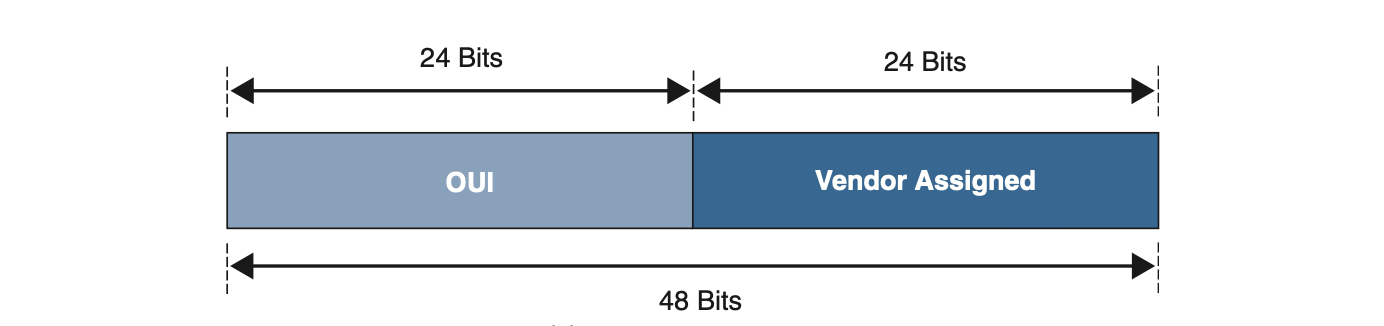
- 48 bits organized as 12 hexadecimal numbers
- Mac Address has 2 components:
Organizationally unique identifier (OUI): 24-bit number identifies manufacturer of NICVendor-assigned address: 24-bit number uniquely identifies Ethernet hardware
VLANS
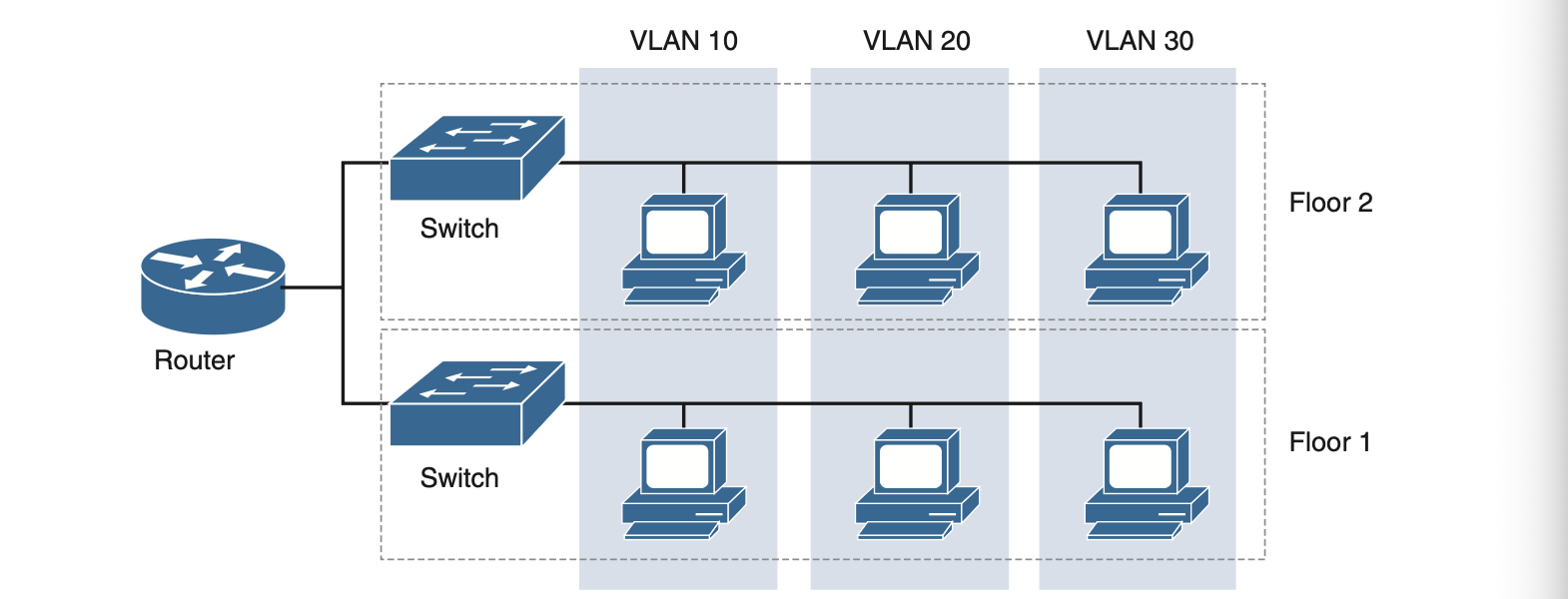
- group of devices on an Ethernet network logically segmented by function, team, application
- students grouped into student VLAN, faculty into faculty VLAN, etc
- standard 802.1q integrated as an 802.1q header in the Ethernet frame
- 12 bits dedicated to VLAN identifier
- max 4094 VLANS per network
- VLAN IDs 0 and 4095 are reserved
- each VLAN defines its own broadcast domain
- no matter what location device is in, it can be a part of the same VLAN

Benefits of VLANS
- creating VLANS and assigning devices to them reduces the size of broadcast domains which reduces chances of broadcast storms
- Easier troubleshooting with logically-grouped devices
- easier to enforce security policies and limit access between VLANS than doing it port-by-port on a switch